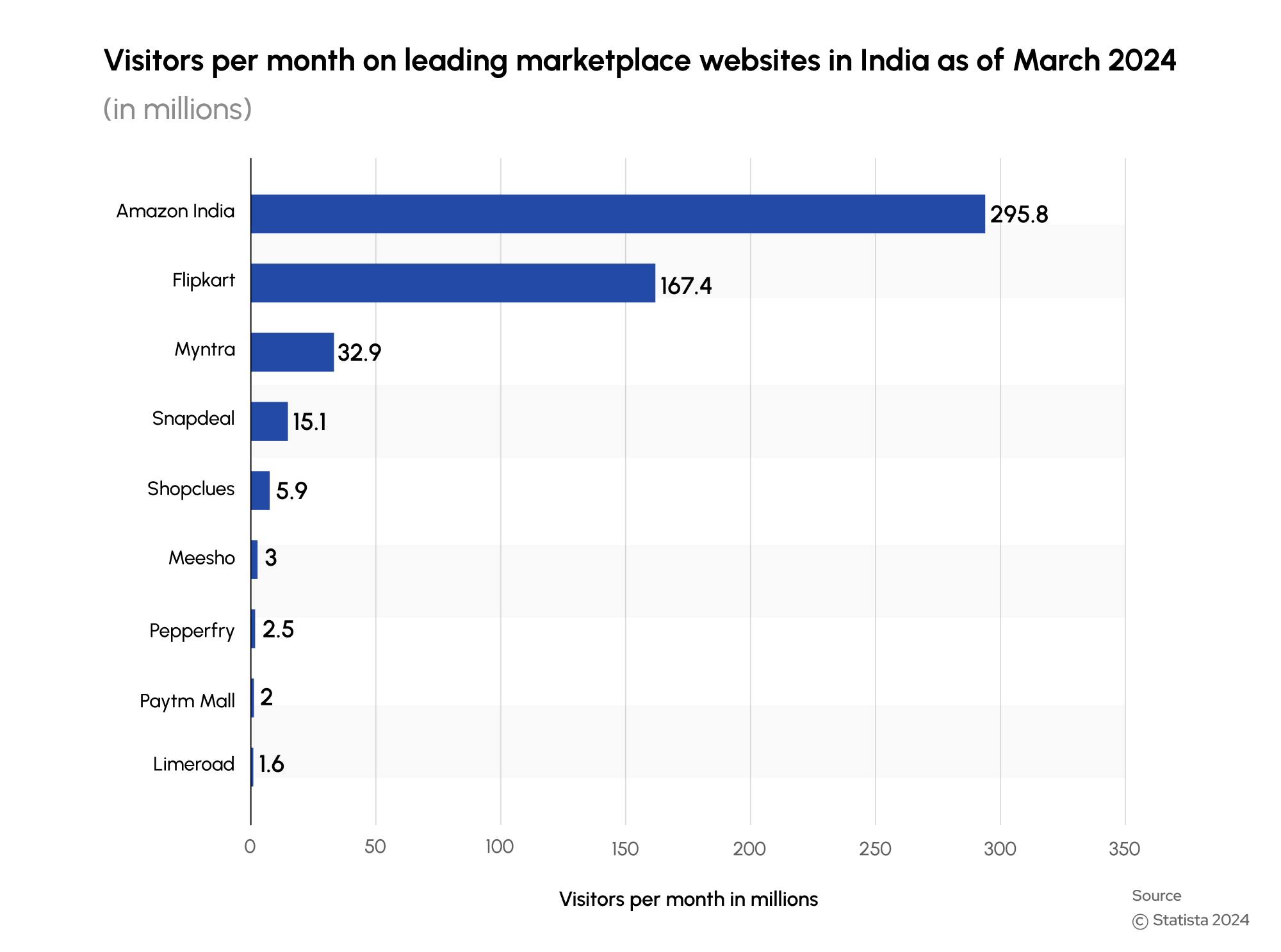
These days, almost everything has moved online. But this shift isn’t exactly new—businesses started going digital way back in the ’90s. What’s different now is that we’re fully in the online era, and more customers are comfortable with online shopping like never before. They love the convenience of browsing products, finding great deals, reading reviews, and getting all the details they need before making a purchase—all from the comfort of home. According to Statista, in 2024 alone, visits to the leading marketplace in India reached more than 295 million visitors, and this statistic is up to March alone. Just imagine how much this number would have increased by now.

With AI’s recent growth, online shopping is evolving even further. AI-powered tools are making it easier for customers to find what they’re looking for by offering personalized assistance and seamless shopping experiences.

What is Conversational Commerce?

Simply put, conversational commerce brings together messaging platforms, chatbots, voice assistants, and shopping. It allows you to interact with businesses in real-time, through platforms you’re already using, like WhatsApp, Facebook Messenger, or even Alexa. Instead of navigating complex websites or waiting on hold for customer service, you can ask a question or place an order with a simple text or voice command.

The result? A more personalized, seamless experience that feels less like shopping and more like having a conversation with a helpful friend.

Why is Conversational Commerce on the Rise?

There are a few key reasons why businesses are hopping on the conversational commerce bandwagon:

  1. Everyone’s on their phone: Let’s face it, we live on our smartphones. Whether it’s texting friends or scrolling through social media, we’re always connected. So, why not make shopping and customer service just as easy through messaging apps?
  2. AI is smarter than ever: Gone are the days of clunky, robotic chatbots. Today’s AI-powered bots understand natural language and can give intelligent, personalized responses. It’s like having your own shopping assistant on call 24/7.
  3. Customers want speed and convenience: We’re all about instant gratification these days. Conversational commerce allows businesses to respond to customer needs in real time, making the shopping process quicker and easier than ever.

How Conversational Commerce Boosts Customer Engagement

Now that you know what conversational commerce is, let’s talk about how it’s changing the game for customer engagement.

1. It Feels Personal

Picture this: you’re chatting with a brand’s bot, and it not only remembers your name but suggests products based on your past purchases. Pretty cool, right? That’s the power of personalization. Through AI, businesses can tailor recommendations and responses based on your preferences, shopping history, and even browsing behavior.

For instance, if you always buy the same skincare products from a beauty brand, the chatbot might suggest a new product line that fits your skin type. This personalized approach not only makes you feel valued but also encourages you to stay loyal to the brand.

2. It’s Always On

We’ve all been there: it’s late at night, you need help with an order, but customer service is closed. With conversational commerce, that’s not an issue anymore. Chatbots and AI assistants can work 24/7, giving you the support you need when you need it.

Whether a customer is checking on the status of a delivery or asking about a product feature, a chatbot is always available to answer your questions. This around-the-clock availability keeps customers happy and engaged, ensuring that help is always just a message away.

3. Instant Responses

No one wants to wait. We want answers, and we want them immediately. With conversational commerce, businesses can respond to customer queries almost instantly, eliminating the frustration of long wait times.

Instead of scrolling through endless FAQs or waiting on hold, customers can simply ask the chatbot, “Is this product in stock?” or “When will my order arrive?” The faster you get answers, the more likely you are to stay engaged and make a purchase.

4. It Simplifies Shopping

Let’s say you’re ready to buy something but don’t want to jump through hoops to make the purchase. Conversational commerce makes this easier by allowing you to complete transactions right in the chat window. You can ask for recommendations, select a product, and even make a payment—all within the same conversation.

This seamless process not only saves you time but also reduces the chances of cart abandonment, making it more likely that you’ll follow through with your purchase.

5. Keeps Customers Coming Back

The beauty of conversational commerce is that it doesn’t stop once the purchase is made. Brands can continue to engage with you after your transaction, offering follow-up support, exclusive discounts, or even checking in to see how the customer liked your product.

This ongoing conversation builds trust and keeps you coming back for more. Plus, when a brand takes the time to follow up, it shows they care about your experience, fostering loyalty and making it more likely that you’ll choose them again.

6. Boosts Sales with Cross-Selling and Upselling

Have you ever added something to your cart, only to have a chatbot suggest a complementary product? Maybe you’re buying a new phone, and the bot recommends a case or a screen protector. That’s cross-selling in action. Similarly, if you’re looking at an entry-level product, the bot might suggest a premium version, offering more features.

These smart recommendations not only enhance your shopping experience but also increase the chances that you’ll spend more, benefiting both you and the business.

Real-World Examples of Conversational Commerce in Action

Amazon’s Rufus AI

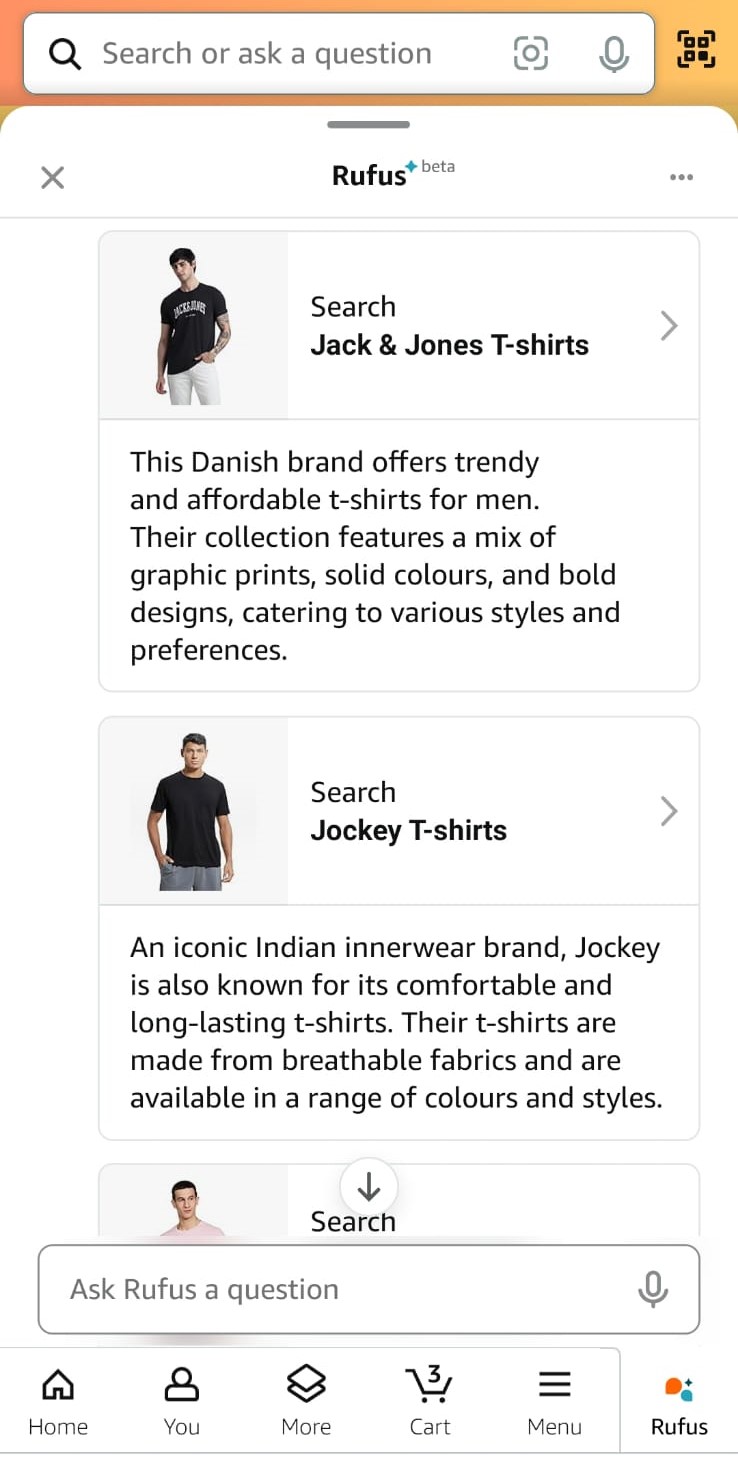
Amazon has taken a significant step forward with the beta release of its AI assistant, Rufus. Designed to enhance the shopping experience, Rufus helps customers discover products based on their search queries, budget, and shopping habits. While still in development, this AI bot already delivers impressive results, making product recommendations that align with user preferences.

For example, when asked to suggest reputable men’s T-shirt brands, Rufus provided a selection of quality options. As the AI continues to evolve, we can expect it to become even more intuitive, offering personalized suggestions that help shoppers find exactly what they’re looking for—quickly and efficiently. This marks a promising advancement in how people interact with online shopping, paving the way for a smoother, more tailored experience as the AI learns and improves over time.

Soon, Rufus could become an indispensable tool, streamlining the way customers discover products, saving time, and making shopping more enjoyable.

The Challenges of Conversational Commerce

Of course, no technology is perfect. While conversational commerce offers plenty of benefits, there are challenges too. Ensuring data privacy and security is crucial, especially when customers share sensitive information like payment details. Additionally, while AI has come a long way, chatbots can sometimes struggle with more complex queries that require human intervention.

Final Thoughts

Conversational AI in e-commerce is quickly becoming the future of online shopping, and it’s only a matter of time before it becomes the new norm. Many big brands have already embraced this shift, implementing advanced strategies to capture their customers’ attention and enhance the shopping experience. But here’s the exciting part – you don’t have to be a large retailer or a big brand to benefit from this technology.

As a leading e-commerce development company in Chennai, we can help you integrate conversational AI into your online stores. With our expert guidance, you can offer real-time support, personalized recommendations, and seamless interactions that keep your customers coming back. Get in touch with us today, and let’s explore how we can help transform your online store with conversational AI!
Online shopping has revolutionized the way Indians buy products. Thanks to the proliferation of e-commerce platforms such as Amazon, Flipkart, and Shopify, people now have the convenience and confidence to purchase goods online. These platforms have built a reputation for delivering products promptly, ensuring that customers receive their orders on time. As a result, online shopping has become an integral part of the modern Indian consumer experience.

If you’re business aiming to venture into e-commerce and start selling online, you must partner with one of the leading e-commerce development companies in Chennai. These companies will have the experience and expertise to set up an e-commerce that best suits your customers.

You might think, how do I find them? That’s why we’ve come up with a list of the best e-commerce development companies in Chennai. Evaluate and choose the company that best suits your e-commerce needs.

Here is a List of Top Ecommerce Development Companies In Chennai

Absolute App Labs has attained the top position by offering comprehensive e-commerce services to its customers. With their extensive knowledge and experience working with a variety of e-commerce platforms, such as Shopify, Magento, and WooCommerce, they offer a wide range of services, from setting up stores to seamlessly migrating businesses to different platforms. Their expertise guarantees that businesses receive top-notch support, as well as tailor-made solutions that fit their specific needs.

Founded In: 2021

Services: E-commerce store development, App development, E-commerce web development, Migration services, E-commerce consulting, e-commerce maintenance and much more!

2. BrandStory

BrandStory, with its innovative approach to e-commerce development, has successfully catered to the diverse business needs in India. The company’s focus on creating unique brand identities has made it a preferred choice for businesses seeking e-commerce solutions.

Founded In: 2014

Services Offered: E-commerce consulting, E-commerce store setup, E-commerce web development, e-commerce marketing.

3. Blazedream

Blazedream is a leading provider of top-notch e-commerce web design and development services, catering to businesses of all sizes. Their unparalleled focus on e-commerce website design and frameworks has earned them a reputation as the go-to experts for creating bespoke e-commerce stores that are tailored to match each business owner’s unique vision.

Founded In: 1999

Services: E-commerce consulting, E-commerce website design and development.

4. KP Webtech

They’re another e-commerce expert businesses can rely on if they want to create an e-commerce store. These have extensive experience working with different platforms and possess exceptional design skills to create visually appealing and functional e-commerce stores that cater to the unique needs of businesses.

Founded In: 2020

Services Offered: E-commerce website development, E-commerce integration, Payment gateway integration, e-commerce website re-design, e-commerce marketplace and maintenance.

5. Dezvolta

Dezvolta is a highly specialized company that provides exceptional website development and design services to a diverse range of businesses. Their expertise lies in creating highly functional e-commerce websites and developing cutting-edge applications that cater to the unique needs of their clients. At Dezvolta, customer satisfaction is the top priority, and they work tirelessly to create outcomes that exceed expectations.

Founded In: 2011

Services Offered: E-commerce consulting, e-commerce design and development.

6. Madro Digital

One of the e-commerce development companies you can count on the expertise of Madro Digital. Their extensive experience with different e-commerce platforms empowers them to design and develop a custom store specifically tailored to your business and your desired customer base. You can trust them to create a user-friendly and visually appealing online store that maximizes your sales potential.

Founded In: 2016

Services Offered: Magento website development, e-commerce website maintenance, WooCommerce website development, custom e-commerce website development.

7. iStudio Technologies

iStudio Technologies is a highly proficient and seasoned player in the domain of e-commerce development. Their extensive experience in the e-commerce field enables them to offer a comprehensive range of services that cater to all the diverse needs of an e-commerce store. With a proven track record of delivering successful e-commerce solutions, iStudio Technologies is a reliable and trusted partner for businesses looking to establish a strong online presence and drive growth.

Founded In: 2008

Service Offered: E-commerce website development, M-commerce service, social commerce services, Magento store development, WooCommerce store setup, Vendor management, and much more!

8. Spidergerms

Spidergerms is a highly experienced and reliable e-commerce web development service provider with more than a decade of experience. They have a proven track record of working with various e-commerce platforms, and they possess an in-depth understanding of the business that approaches them. Their team of experts works diligently to create an exceptional online store that seamlessly enhances the customer’s experience.

Founded In: 2014

Services Offered: E-commerce website development, custom e-commerce development, e-commerce development strategies, e-commerce platform migration, e-commerce website re-design.

9. Ocean Softwares

Ocean Softwares is a highly reputable e-commerce development company that has successfully assisted numerous businesses in setting up their online stores. With their extensive knowledge and experience in various platforms, they offer comprehensive and customized e-commerce solutions that cater to the specific needs of business owners in Chennai.

Founded In: 2014

Services Offered: Custom product pages, custom workflow development, warehouse management, e-commerce website development, custom e-commerce development, abandoned cart recovery.

10. Indglobal

For almost a decade, Indglobal has been a leading provider of top-notch e-commerce development services for businesses of all sizes. Their comprehensive and tailored solutions have empowered numerous businesses to establish and grow their online presence by creating an e-commerce store that meets their unique needs and objectives.

Founded In: 2010

Services Offered: E-commerce website development, Magento store development, Shopify store development, WooCommerce store development.

Conclusion

These companies have gained their top spot by providing holistic e-commerce services to businesses. With their in-depth knowledge and expertise in various e-commerce platforms, they possess the necessary skills to create e-commerce stores with precision and accuracy. If you’re planning to establish your e-commerce store, it’s highly recommended that you partner with one of the top e-commerce development companies to ensure a seamless and outstanding outcome.

Shopify has been the go to solution for many entrepreneurs looking to start their eCommerce journey. With its ease of setting up your store to the fact that your store will be scalable as your business grows, Shopify has cemented itself as a reliable eCommerce platform. So, settling for Shopify as your platform makes sense, especially if you read our eCommerce platform comparison blog.
The cost to run a Shopify store varies drastically depending on the plan you choose, additional plugins you opt for, and so on. So, the question that has to be asked is, How much does it cost to run a Shopify store? Well, we’re here to answer just that! At the end of this article, you’ll precisely know how much it would cost to run a Shopify store.

Shopify Pricing Plan Comparison: How Much Does Shopify Cost?

To kickoff your eCommerce journey you gotta start with getting the basics right. So, let’s quickly see the price structure of Shopify to get a peek at how much does it cost to run a Shopify store. It’s important to understand the various plans offered by Shopify to figure out which one would suit your business well.

Basic Shopify – $29/month

The basic plan is the most affordable plan that Shopify has to offer for you. This plan covers all of the essential features that many small businesses would need, such as, 24/7 customer support, blog creation, 2 staff accounts and unlimited product listing. Most importantly, you also get abandoned cart recovery to target your visitors in a personalized manner.

The drawback? you wouldn’t be able to make data driven decisions because of the lack of professional reporting. Not accessing to comprehensive reporting will surely impact your business in the long term. However, like we said before, basic Shopify would suffice for many small businesses.

Oh, we can’t forget another important thing. The transaction fees. On a basic Shopify plan, the transaction fee would land around 2.9% + $0.30 per transaction for all purchases. There’s one more catch here to consider. This is applicable only if you use Shopify payment gateway. If you opt for any of the third party payment providers, you will be charged additionally by 2% on every order.

Shopify – $79/month

Regular Shopify is the most sought after plan that many eCommerce travelers are preferring. This plan stands right at the middle and it facilitates many features that you would want to maximize your business growth.

Majorly, Shopify plan bumps up your staff accounts to 5 and of course. You’ll get a professional report to get valuable insights. With much-needed data at your hand, you can make impactful decisions that matter a lot. Hey, numbers don’t lie, yes? 

As for the transaction fee, you’ll be charged 2.5% + $0.30 on every online credit card transaction. In this plan, the additional transaction fee for third party payment gateway reduces to 1%.

Advanced Shopify – $299/month

We can just straight up say that, If you’re a small to mid sized business or just starting out in the eCommerce game, this wouldn’t be a good option for you. Advanced Shopify comes with a whopping price tag of $299 a month, so you get what we’re trying to say.

Advanced Shopify caters all the available features of basic and Shopify plan. One of the major selling points of this plan is the integration of third party shipping partners. With different shipping partners at your hands, your customers can choose the shipping partner that they prefer based on the shipping charge that the delivery partners levy.

The transaction fee for Advanced Shopify plan reduces even further at 2.4% + $0.30 per transaction. If you opt for third party payment gateways, you can enjoy the reduced additional fee of 0.5% on orders.

Additional Costs to Consider While Setting Up Your Shopify Store

Apart from spending on Shopify subscription costs, you would have to spend for the below requirements too. Keep in mind that the these numbers are the highest estimate to run your Shopify store. We can reduce the cost even further but we’ll talk about it later on.

Custom Design & Development

Tailoring your store’s design to match your brand identity often involves hiring a Shopify developer and a designer. This expense covers creating a unique layout, implementing custom features, and ensuring a seamless user experience.

The total development cost for this would come around $2000 – $5000 depending on the design and the development team that you choose. This is a one time payment, so think and decide according to your budget.

App Integration

Shopify’s app store is a treasure of applications designed to expand your store’s capabilities. Many applications are free or offer basic functionalities at no cost, but advanced features or increased usage might require paid subscriptions.

Although the costs for app integration varies heavily on your requirements, an average Shopify owner has about 6 Shopify apps on their eStore. Based on this, the budget for Shopify apps would land about $120 a month, that if you fall under this category.

Marketing

What’s the point of building your store if you can’t reach new customers? To do that In this competitive era, you have to implement various marketing and advertisement strategies like Google ads, SEO and so on.

Marketing costs for running a Shopify store totally depend on your budget. On an average, you can expect this to go around $1500 a month for you. If you feel like it’s too much for you, you can always reduce this too by crafting a good marketing strategy tailored for you.

Maintenance

While Shopify is effortless to maintain on your own, you might need Shopify developers to help you with maintenance, bug fixes and other technical support if any situation occurs

To maintain your eStore with the a professional’s help, you can expect the time for maintenance would come around 10 hours a month. Based on the average cost of hiring a developer, the cost for maintenance will be $500 a month. And of course, it’ll differ from one company to another.

So, Which is the Best One For You?

If you’re a small sized business owner or trying to plan your foot in the eCommerce sphere for the very first time, Basic Shopify would be straight up enough for you! As a matter of fact, basic Shopify is what we as a trusted Shopify development company, would recommend for even mid sized businesses.

Other than the question “How much does it cost to run a Shopify store” you are likely to have another question just like thousands of people out there. “Why shouldn’t I just opt for Magento, WooCommerce or any other eCommerce platforms?”

Before we dive a bit deeper, we just gotta mention that It absolutely makes sense why you would think that. Magento is an open source eCommerce platform. It could make you think the costs for developing a Magento store would be less compared to Shopify. And WooCommerce is a plugin for WordPress and this could make you think you might have more control over your store and the customization aspect of it.

Yes, you might have more control and more customization options but at what cost? The cost for developing a whole new eStore from scratch will definitely put a hole in your pocket. Not to mention the fact that you would have to spend separately for SSL certificates in the other two unlike Shopify which offers SSL certificates for every plan.

And Here’s the Bottom Line,

If you’re a fresh mind looking to dominate eCommerce with your reliable products, Shopify would be the simple and cost effective way for you to get your eStore up and running in no time. Not to mention the fact that with Shopify, you would need no helping hands to run the store. You can basically use it on your own once you get the hang of it.

Now, let’s take a look at the detailed table we have for you to grasp the cost spent for your Shopify store quickly.
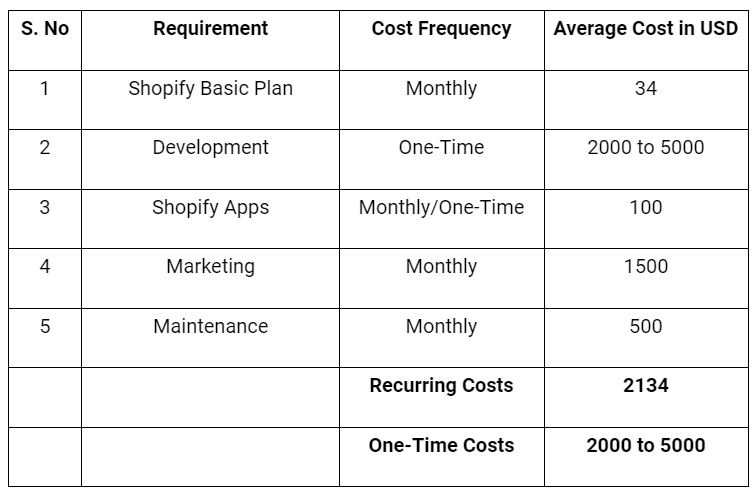
Bear in mind that, what we have mentioned here is the highest estimated cost for running your Shopify store based on the number of Shopify clients we have worked with. It is indeed possible to cut down this cost much further based on your requirements.

To know how much does it cost to run a Shopify store tailored for you, reach out and book a free discovery call with us! With our extensive experience with developing Shopify stores, we would we able to align with your budget while meeting the high standards of the market.

Choosing the best eCommerce platform for your business is a crucial decision in the long term perspective. Whether you’re a small startup or a well-established enterprise, choosing an e-commerce platform plays a significant role in your online success. So you go out there and search for the best eCommerce platform and what do you see? An abundant amount of choices! You will be bombarded with N number of options leaving you more confused.

Well, we’re here to put an end to your confusion!

In this eCommerce platform comparison, we’ll walk you through some of the best ecommerce platforms available in 2023 to help you make the right decision. So, wait not, and let’s jump right into it.

Shopify

Shopify is one of the most popular ecommerce platforms in the market today, known for its simplicity and user-friendliness. It’s an excellent choice for small to medium-sized businesses and startups looking to establish an online presence quickly. Let’s see the pros and cons of Shopify real quick.

Pros of Shopify

Simplicity: Shopify offers an incredibly user-friendly interface that doesn’t require extensive technical knowledge. Setting up an online store is straightforward, making it accessible to beginners.

Hosting: Shopify is a fully hosted platform, which means you won’t have to worry about web hosting. This convenience takes a significant load off your shoulders.

Scalability: While Shopify is often associated with small businesses, it can scale to accommodate larger operations. You can upgrade to high-tier plans as your business grows.

Mobile Optimization: With a focus on mobile commerce, Shopify provides responsive themes and a smooth shopping experience for your customers.

App Store: The Shopify App Store offers a vast array of plugins and apps to extend your store’s functionality. Whether you need marketing tools or any software to improve the experience, you’ll most likely find it here.

Cons of Shopify

Monthly Costs: The Shopify pricing structure is designed kinda rigorous. The basic plan would cost you ₹1,994 a month. If you want to enjoy additional features and custom reporting it’ll cost you anywhere from ₹8,000 to a whopping ₹30,164 a month.

Transaction Fee: You may incur transaction fees on top of credit card processing fees if you don’t use Shopify Payments for payment processing. Kind of a bummer.

Dependency on Shopify: Your online store essentially relies on Shopify’s infrastructure, which means you have less control over website UI. But you can overcome this by hiring the best eCommerce developers.

Magento

Magento is an open-source platform favored by larger businesses and enterprises. It offers a high degree of flexibility and customization options but can be more complex to manage. With Magento, you have complete control over your store’s design and functionality, making it ideal for those who need a highly customized ecommerce solution. Let’s jump to the pros and cons now.

Pros Of Magento

Unmatched Customizability: Magento is renowned for its flexibility and customization options. You have complete control over your store’s design and functionality.

Scalability: Magento can handle the big digital baggage that you throw out. This simply makes it one of the best ecommerce platforms for large enterprises.

Open Source: Being open source means you have access to the source code, allowing you to modify and adapt your ecommerce site to meet your specific needs. Ecommerce developers can indeed materialize on this opportunity to their benefit.

Robust SEO: Magento offers extensive SEO capabilities and allows for fine-tuning, which can significantly boost your store’s search engine rankings.

Cons Of Magento

Complexity: Magento’s power comes with a bitter aftertaste. It’s not a platform for beginners and you may need to hire ecommerce developers or a dedicated team to manage your store.

Server Management: Running a Magento store demands substantial server resources, which can be costly. But it completely depends on your choice and you may have to have a dedicated hosting to ensure optimal performance.

Learning Curve: Learning to use Magento can be time-consuming, and it might not be the best choice for those who need a quick setup.

Licensing Cost: While the Community Edition of Magento is free, the Enterprise Edition (now Adobe Commerce) comes with a hefty price tag. It varies drastically depending on the ecommerce developers you choose and the features you’d like to have.

WooCommerce

The WordPress-Powered Choice WooCommerce is an e-commerce plugin for WordPress, making it an attractive option for those who are already familiar with the WordPress platform. It’s an ideal choice for small to medium-sized businesses and those who value the content management capabilities of WordPress. Since we’re here to find out the best ecommerce platform for you, we have to dive a bit deeper. Let’s do that.

Pros Of WooCommerce

Familiarity: If you’re comfortable with WordPress, you’ll find WooCommerce intuitive and easy to use, as it seamlessly integrates with your existing WordPress website.

Cost-Effective: WooCommerce is open source and free, which can be a significant cost-saving for small businesses. You only need to pay for web hosting and premium extensions if necessary.

Flexibility: Having WordPress at its heart, WooCommerce allows you to create content-rich e-commerce sites, ideal for content marketing and SEO strategies.

Customization: With your knowledge or by relying on WordPress development company, you can have control over your store’s design and functionality, similar to Magento.

Cons Of WooCommerce

WordPress Dependency: While WordPress is a popular platform, you’re dependent on its ecosystem, which may not be suitable for all businesses. However, you can leverage the expertise of developers to make your website truly yours.

Technical Maintenance: As an open-source platform, you’ll be responsible for the technical aspects of your store, including updates and security.

Limited Built-in Features: Some features that come standard in other platforms require additional plugins or custom development in WooCommerce. As we said, you can leverage the expertise of WordPress development company to overcome this.

BigCommerce

BigCommerce is a relatively new but rapidly growing ecommerce platform in 2023. It strikes a balance between ease of use and powerful features. It accommodates businesses of all sizes and includes a robust set of ecommerce features out of the box. With BigCommerce you can easily across multiple platforms as well. This simply makes it one of the best ecommerce platforms in 2023, you can rely confidently on. Let’s take a bite at its pros and cons quickly here.

Pros Of Bigcommerce

User-Friendly: BigCommerce offers an intuitive interface with a wide array of features, making it accessible for users of all experience levels.

Scalability: This platform suits businesses of all sizes, adapting seamlessly as your enterprise expands, similar to Shopify’s scalability.

Built-in Features: BigCommerce comes equipped with a comprehensive set of e-commerce features, minimizing the necessity for third-party plugins.

Good SEO Tools: BigCommerce offers crucial SEO tools, assisting your store in achieving high search engine rankings.

Cons Of BigCommerce

Pricing: BigCommerce’s pricing tends to be on the higher side, which may be less budget-friendly for small businesses. The pricing starts from ₹2400 a month all the way up to ₹24000 a month for the Pro version. You can opt for the Enterprise version of the same, but you’ll have to get in touch with the team to get a quote for your project.

Transaction Fees: Similar to Shopify, you might encounter transaction fees if you opt not to use their payment gateway, which can add to operational costs. Like we said for Shopify, kind of a bummer.

Technical Expertise: While BigCommerce is more user-friendly than platforms like Magento, it still demands a certain level of technical understanding. Integrating third-party systems or making extensive code customizations, might require assistance from a developer or additional technical expertise.

So, What Is The Best Ecommerce Platform You Should Choose?

While we love to give you a single conclusive platform to be the best ecommerce platform in 2023, we can’t point our fingers and say that. So, let’s summarize the blog quickly here.

For simplicity and scalability, Shopify is an excellent choice, particularly for smaller to medium-sized businesses. If your needs lean towards customization and you have the resources to manage complexity, Magento caters to just that. WooCommerce, a cost-effective option that integrates seamlessly with WordPress, suits those familiar with the platform the most. Meanwhile, BigCommerce strikes a balance between user-friendliness and powerful features, accommodating businesses of various sizes.

It’s quite evident that Shopify, Magento, WooCommerce, and BigCommerce – have their distinct advantages and limitations. Hence, the best ecommerce platform for your business completely depends on your budget, technical knowledge, long-term growth strategies, and many other factors that may be concerning to you.

Still confused about which platform to go for? You can simply hire the best ecommerce developers to help you from consultation to building your visionary ecommerce website that speaks to your customers.

Don’t hesitate and let’s chat over a cup of coffee to discuss the growth of your business in the ecommerce sphere!

Today, eCommerce encompasses the entire process of operating a business online and goes far beyond the simple act of buying and selling goods. With nearly 2 billion digital consumers worldwide, creating an eCommerce website is still a smart business move. Creating an e-commerce website might be easier than you think. The majority of the work can now be done for you by ecommerce platforms, but you still need to know what is available and what your website requires. If you do your research, you can make choices that result in an excellent site that expands and scales alongside your business over time.

If you need support in building the same, don’t hesitate to reach out to the Top ECommerce development company in Chennai. We’ve compiled the characteristics of a successful eCommerce website as well as a few crucial considerations:

eCommerce Platform

Online retailers can manage their websites, sales, marketing, and operations with the aid of an eCommerce platform. Order tracking, payments, refunds, and replacement processes are handled by these platforms. Additionally, it gives you sales profit and loss reports on a weekly, monthly, or annual basis. Some of the best eCommerce platforms are listed below,

Shopify

Shopify is a subscription-based service, with its basic plan costing $29 per month. It is simple to set up and use. You can set up the store and go live within a day using Shopify. Several payment methods are available for a store, including PayPal, Meta Pay, Amazon Pay, Google Pay, and Apple Pay. The platform has a great variety of pre-built themes and is simple to integrate with apps for various functionalities. The platform has an incredibly quick loading speed, and any e-commerce built on it loads in just a few seconds. It also provides staff management, smart inventory management, check-out, products, customers, reporting, and marketing.
Shopify offers a complete package for a business owner to set up an eCommerce store.

WooCommerce

WooCommerce is an e-commerce plug-in for WordPress. WooCommerce is the leading online shopping platform in terms of sales and accessibility . This is the best option if you have a WordPress blog/website and want to sell your products online. WooCommerce is a free and open-source platform. In order to improve the functionality of your site, you can either incorporate commercial extensions or make a custom design for the store. By using the features that are already built-in, you can sell physical, digital, and affiliate products. Ajax shopping cart and geolocation-related support, a flexible design, tax, and shipping calculation, Google analytics integration, and SEO optimization are some added advantages.

All these technicalities might sound complex, but these make WooCommerce one of the best choices for eCommerce development for small and medium-scale businesses.

Magento

Magento is one of the best platforms for large-scale enterprises due to its scalability and customization options. It can hold and handle a large number of data and transactions seamlessly.

Magento has a wide range of integrated features. You can add coupons, produce in-depth reports, alter the language and currencies, and offer discounts on particular goods or to loyal customers, among other things. Additionally, a wide variety of extensions and templates are available with Magento Open Source. You can create multiple online stores with Magento and manage them from a single administration panel.

Choose the right platform based on your requirements and start setting up your store. If you are confused about deciding which platform would suit your needs, you can reach out for a free consultation with us.

Choosing a Design to build a Ecommerce website

The way your eCommerce store is designed, the customer journey, clicks to buy, etc. matter a lot when it comes to user experience. But, creating and implementing a design differs from platform to platform and it is important to be aware of the differences and their implications.

To start with, Shopify does allow a custom design, however, the preferred method in Shopify would be purchasing a pre-built theme. The theme is then integrated with your website and all your products/pages are created in the store. Purchasing a pre-built theme is the easiest and can help you set up the store quickly. However, if you still wish to go ahead with a custom design, for your business is very niche or you couldn’t find a theme, you can do so. Once the design is made, a theme is built based on that and implemented on the site.

With WooCommerce, there is an option to choose a pre-built theme, however, the platform offers the best customization capabilities. Hence, if you are building a store with WordPress and WooCommerce, the best approach is to go for a custom design. If you are looking for design experts who can help you with your WooCommerce store, we can help. Contact our experts today to get a view of our previous designs.

Magento offers the most flexibility when it comes to design. As stated before, Magento is a platform used to build enterprise eCommerce stores. This would be most suited for niche businesses whose work doesn’t fall under any of the general industry categorizations. In this case, a screen-by-screen custom design is the best option for your business and such design and development are highly feasible with Magento.

Also, it is important to ensure that the color scheme of your website goes well with the goods you’re selling. For example, Green, yellow, and purple color schemes are good for food-related eCommerce because they pique the appetite. Additionally, there needs to be a lot of white space so that the food items and website design don’t clash. Understand your industry and choose a theme/design accordingly. An expert eCommerce design team can help you in this regard.

Product Catalog

A catalog is a vital component of marketing online because it informs your customers about what you have. Information like color and size options, size grids, materials, country of origin, and in-depth product pictures or videos are all included in e-commerce product catalogs. Also included is a price breakdown for each good or service that you offer. The customer will respond better if you provide them with comprehensive images, descriptions, and prices of your products.

With more knowledge of your audience and their journey, you can build catalogs for them. For each customer profile you have identified, you could create a unique product catalog that only shows items that are pertinent to their interests. Your catalog should also provide extensive filters that would help your customers go through and search your products seamlessly.

Multiple Payment Options

Providing multiple payment options on your e-commerce website is crucial, as customers may decide against making a purchase if they can’t use their preferred method. Offering a variety of payment options also fosters user credibility and builds trust, which will encourage people to buy right away. Additionally, the ease with which users can check out may encourage higher transaction amounts.

You should make the appropriate investments in the right tools to make accepting payments on your store or website as simple and frictionless as possible. You can give your customers exactly what they want in a short amount of time by using a proper and flexible payment gateway. Some of the best payment gateway integrations are,

  1. CashFree
  2. Paytm
  3. RazorPay
  4. IppoPay
  5. PayU

Shipping

Your brand’s shipping method is crucial for success; if customers can count on quick delivery, their preferred options, and excellent customer service, their trust in your company will grow. Customers’ delivery experiences can also be improved by the following ways:

  • Online tracking that is precise and clear. Despite the fact that many couriers will inform you that an order is out for delivery, tracking options that provide specific information like expected delivery times are much more helpful.
  • SMS notifications can be very useful in this situation. Some couriers, for instance, give customers updates on anticipated delivery slots or offer the chance to make changes.
  • Effective communication when issues arise. Maintaining open lines of communication with your customers is essential.

These days there are multiple integrations available for all eCommerce platforms that offer the best shipping options (in terms of pricing) and experience. All you need to do is integrate one or multiple of these shipping integrations into your store. From printing labels to tracking, to bulk order processing, everything is possible. Some of the best shipping integrations for India are the following,

  1. Shiprocket
  2. NimbusPost
  3. EasyPost
  4. EShopBox

Your e-commerce strategy will benefit from having great delivery options because they will help with customer service and retention.

Reviews and Ratings

Despite the fact that many small businesses worry that bad reviews will hurt their reputation, accepting criticism can actually help your company, especially if you deal with issues quickly. You can enhance your brand’s reputation and begin to develop trust by providing customers with a platform to express their opinions. To become more credible to potential customers and the general public, every online business needs product reviews for e-commerce. If you incorporate these reviews into your website, there are a tonne of opportunities for brand expansion and financial success. For your website to perform better and generate more revenue, it is advised that you understand the opportunities presented by reviews, where to find them, and how to use review widgets to display them.

Conclusion

Since e-commerce offers so many advantages for online sales and the promotion of your products and services, it has emerged as one of the most successful marketing strategies for small businesses worldwide. Hence, you should have effective eCommerce websites if you want to succeed online. You should make developing an eCommerce website a top priority by working with some of the best custom eCommerce development companies in Chennai or at least DIY initially and get started. This not only benefits your company but also increases the visibility of your brand on a global scale. So, start your online journey today.

Ready to Boost Sales? Launch Your E-Store Today!